 ESPCI web site




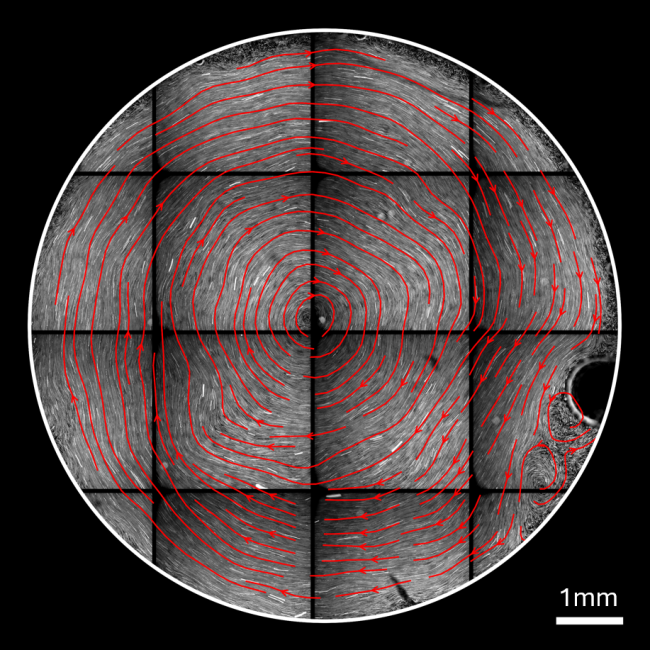
Nature abounds with highly performative collective behaviors, from bird flocks and fish schools to ant colonies and multicellular tissues. Comparable emergent dynamics arise in bacterial suspensions, where hydrodynamic interactions drive self-organization into turbulent flows. These flows are crucial for mixing nutrients essential to sustaining bacterial activity. Current theories offer conflicting predictions about the emergence of these flows and their characteristic scales. Here, well-controlled experiments on Escherichia coli suspensions reveal that flow size scales linearly with confinement, while the critical onset density scales inversely. This strongly constrains existing theories and reveals that bacteria can drive flows ten thousand times their size even at 0.1% volume fraction, implying that such flows may be far more common in nature than expected.
PNAS Vol. 123 | No. 21 May 22, 2026 123 (21) e2600266123 https://doi.org/10.1073/pnas.2600266123


